SnowTec E-302
User manual · version 1.0.0
Contents
1. What it is
SnowTec E-302 emulates recording onto a Soviet portable cassette recorder, the ЭЛЕКТРОНИКА 302-1. Not tape in general — this machine: the numbers come from its passport and circuit diagram. 63 Hz to 10 kHz, 0.4 % wow and flutter, about 44 dB signal to noise, 4.76 cm/s, type I tape, 120 µs equalisation.
That dictates the character: a narrow band, audible pitch drift, tape hiss, mains hum, the soft overload of a small transistor amplifier, and head-gap loss that eats the top end harder the slower the tape runs.
2. Installing
macOS (11+, Intel and Apple Silicon)
- Close your DAW — macOS will not replace a plug-in file that is in use.
- Open
SnowTec E-302 1.0.0.dmgand run the.pkg. The VST3 and the Audio Unit go to/Library/Audio/Plug-Ins/VST3and/Library/Audio/Plug-Ins/Components. - If macOS mentions an unidentified developer, right-click the file → Open → Open. The installer is not signed with an Apple certificate.
- To remove:
Uninstall SnowTec E-302.commandfrom the same image.
Windows (10+, 64-bit)
- Close your DAW and run
SnowTec E-302 1.0.0 Setup.exe. - The VST3 goes to
C:\Program Files\Common Files\VST3, the standalone program toProgram Files\SnowTec. - Built with the static runtime, so no Visual C++ Redistributable is needed.
Restart your DAW afterwards so it rescans plug-ins.
3. Trial and activation
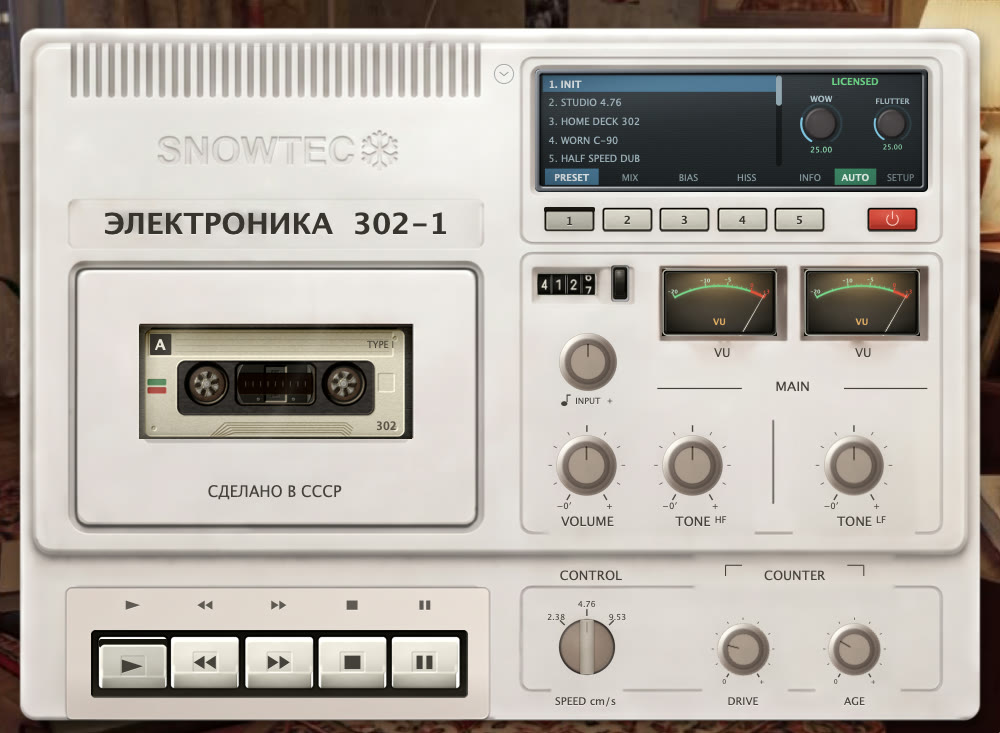
The plug-in runs in full for seven days without a key. The days left appear in two places: on the paper sticker on the cassette label, and in the top right corner of the display. Once activated the sticker comes off the cassette and the corner reads a green LICENSED.
To activate: SETUP → Activate license… → paste the key → Activate. The key is 24 characters and arrives by e-mail right after payment. One key, one machine, for good.
The trial is counted by the server rather than by files on disk, so the first run needs an internet connection. After that the plug-in contacts the server only occasionally.
When the trial ends the sound is muted and a short burst passes every twenty seconds — so it is clear this is the licence and not a fault.
4. Where to put it
- On a single instrument — the most useful place. Drums get their attack squeezed and the cassette's own room; bass gets denser and narrower; vocals lose the digital edge.
- On a group bus — glues several tracks through one path. Most obvious on a drum group.
- On the mix bus — carefully, with small DRIVE. The overload is level-compensated and will not duck the mix, but the machine's band is narrow and on the master that reads as lost air.
- Order: an EQ before the plug-in chooses the tone being recorded, an EQ after it corrects what the tape did. A compressor is better placed after — the tape already squeezes peaks.
5. Input level
INPUT decides how hot the signal hits the tape, and it is the main lever of character. Watch the meters: a needle moving around zero with occasional trips into the red is this machine's working level. Permanently in the red is not "denser", it is dirt.
AUTO on the display compensates the loudness that DRIVE adds: the tone and the saturation stay, the level returns to where it was, and A/B comparison stops fooling the ear.
6. Transport and speed
Five keys at the bottom left — play, rewind, fast forward, stop, pause. By default the deck follows the project transport: press play in the DAW and the spools turn. Pressing a key on the panel takes over until the host's transport state changes.
The counter beside the cassette runs with the tape; the rocker next to it returns it to zero.
SPEED is a three-position switch: 2.38 / 4.76 / 9.53 cm/s. It is not a tempo control: speed moves head-gap loss, hiss and modulation depth together, the way it does on the machine. Half speed is the dub sound, double speed is the cleanest this deck gets.
7. The panel controls
- INPUT — level into the path, see section 5.
- VOLUME — output level.
- TONE (two of them) — the tone of the path, as on the machine: one on record, one on playback. Together they both cut and lift the top.
- DRIVE — how hard the amplifier is overloaded. Level-compensated, so it does not sink the rest of the track under the bass.
- AGE — overall wear: the higher it goes, the more dropouts, noise and unevenness. One control turns a new machine into a battered one.
- WOW and FLUTTER (on the display) — the slow drift of a stretched belt and the fast tremble of the capstan. Their amount is checked with a detonometer built to GOST 24863-87, so "0.4 %" means the same thing here as on the passport.
8. The display and its tabs
The display is a working panel, not a picture. The tabs along the bottom:
- PRESET — the preset list. Scroll with the wheel or trackpad, click to choose, step through with the up and down arrow keys.
- MIX — how much of the processed signal is heard. The path's delay is compensated, so blending does not cause phase cancellation.
- BIAS — recording bias. Underbiased tape is brighter and grittier, overbiased tape closes down. The shelf is inverted exactly on playback, so the control colours the saturation rather than tilting the whole balance.
- HISS — the level of the tape's own noise.
- INFO — what is going on: the deck's state, what the host is reporting, speed, position, output level, auto level and the version.
- AUTO — loudness compensation, see section 5.
- SETUP — skin, licence, key entry, update check, website.
The five buttons under the display are quick preset slots; the red one is bypass. Bypass is honest: no click, no level change, the deck leaves the path completely, the spools hold and the meters go dark.
9. Presets
Fifteen of them. INIT returns everything to the state the plug-in opens in. STUDIO 4.76 is a careful recording on a machine in good order. HOME DECK 302 is the same machine, domestic and worn. WORN C-90 is a tired cassette. HALF SPEED DUB is half speed. BROKEN PIANO is the extreme — a broken mechanism, for effect rather than for a mix. The rest are starting points for drums, bass, vocals and the mix bus.
10. Skin, room, window size
Two skins — an ivory panel and a black one, switched in SETUP → Skin. The choice is remembered with the project.
The deck stands in a room. Above the chassis there is a strip with a grip and a chevron: click it and the room folds away, leaving the machine with a hairline of room around it. To bring it back, use the small engraved button on the panel itself, between the cassette bay and the display. The move is animated and the position is remembered.
The window resizes from any corner. Captions, ticks and figures are drawn as vectors rather than baked into the artwork, so nothing softens as it shrinks.
11. Setting recipes
Drums: a cassette room
Speed 4.76. DRIVE around a third, INPUT set so the needles reach the red on the kick. WOW 20 %, FLUTTER 40 % — movement without the pitch drifting. AGE 25 %. MIX 100 %.
Bass: density without dirt
Speed 9.53 so the top survives. DRIVE 20 %, BIAS a little above the middle. WOW and FLUTTER at a minimum — on long notes pitch drift is heard at once. AUTO on.
Vocals: take the digital edge off
Speed 4.76, DRIVE 15 %, HISS 10 %, AGE 15 %. MIX 60–70 % so the consonants stay from the original.
Mix bus: glue only
Speed 9.53, DRIVE no more than 10 %, WOW and FLUTTER around 10 %, HISS 5 %. MIX 30–50 %. Judge it with AUTO on, or the extra loudness will pass itself off as an improvement.
Deliberate lo-fi
Speed 2.38, AGE and HISS above half, WOW 60 %, FLUTTER 80 %, DRIVE 60 %. Beyond that, the BROKEN PIANO preset.
12. FAQ
The spools do not turn with the project
Open the INFO tab and read the HOST row. PLAY or
STOP means the host is reporting its transport and all is well.
NO AUDIO means the host is not calling the plug-in at all — which
happens on a channel with no sound source on it. NO SYNC means the
host gives no position at all.
The plug-in is not in the list
Restart your DAW: scanning happens at launch. In Live use Rescan in the Plug-Ins preferences. In Logic it appears under the SnowTec category.
Moving the licence to another computer
One key, one machine. Write to support with your key and we will move it.
How heavy is it on the CPU?
Oversampling of the path is the main cost. With the transport stopped the spools and the metering do not waste time.
Does AUTO change the sound?
No. It is a plain output gain compensating the loudness DRIVE adds. The waveform and the saturation are untouched.
Where is the licence kept?
macOS: ~/Library/SnowTec/E-302. The folder can be backed up with
the system — you will not need to activate again.